Aug 2, 2010

What is going on at Paedergat Basin?


The project Will Improve Water Quality, Create Ecology Park and Restore Jamaica Bay Wetlands

The New York City Department of Environmental Protection announced the registration of a $15 million contract to restore 38 acres of wetlands and natural grasslands adjacent to the Paerdegat Basin Combined Sewer Overflow (CSO) Facility located on the shores of Jamaica Bay in Brooklyn. The registration means that the contractor, Tully/Posillico Civil, can begin to mobilize so the stimulus-funded project can get underway.

“This investment will greatly improve the ecology of the Paerdegat Basin area,” said Environmental Protection Commissioner Cas Holloway. “When finished, the community will be able to enjoy a five-acre ‘Ecology Park’ teeming with native plant life. The combination of absorbing more stormwater and the creation of tidal wetlands will improve water quality in Paedergat Basin. This is just one part of DEP’s larger commitment to improving water quality and ecology in Jamaica Bay.”

The project will help absorb stormwater by reintroducing local plant life and restoring the shoreline. Five acres of parkland will become an “Ecology Park,” which will offer access to salt marshes and grassland area and include educational exhibits about coastal habitats. Construction is expected to begin this spring and completed in January 2012, with public access in 2013. The project is funded through Clean Water State Revolving Funds — a program administered the New York State Environmental Facilities Corporation — that were authorized under the American Recovery and Reinvestment Act.

The restoration will complement the $357 million capital investment that DEP is making in building the Paerdegat Basin Combined Sewer Overflow (CSO) abatement project, which will store 50 million gallons of CSOs during storms. When stormwater surges into sewers it can trigger CSOs when sewers and treatment plants reach capacity, which by design protects the sewer system and treatment plants. CSO tanks reduce this problem by storing flows until storms pass, allowing for release and treatment. The City continues to invest in major infrastructure projects that improve the wastewater treatment system and has budgeted $1.9 billion in capital improvements. The City is also taking steps to incorporate sustainable strategies that keep stormwater from reaching sewers in the first place.

DEP manages the City’s water supply, providing more than 1 billion gallons of water each day to more than 9 million residents, including 8 million in New York City, and residents of Ulster, Orange, Putnam and Westchester counties. New York City’s water is delivered from a watershed that extends more than 125 miles from the City, and is comprised of 19 reservoirs, and three controlled lakes. 6,600 miles of water mains, tunnels and aqueducts bring water to homes and businesses throughout the five boroughs, and 7,400 miles of sewer lines take wastewater to 14 in-City treatment plants. DEP also manages storm water throughout the City, and ensures that the City’s facilities comply with the Clean Water Act, and other federal, state and local rules and regulations. The DEP police protect the watershed and its facilities (including seven wastewater treatment plants), and the agency’s HAZ-MAT unit responds to hazardous materials emergencies and toxic site remediation. The agency is also responsible for asbestos monitoring and removal, and enforcing the City’s air and noise codes.

Jul 28, 2010

The Youth Paddle That Wasn’t

What do about a dozen Sebago volunteer paddlers do when the youth they were expecting to introduce to kayaking do not show up? They go kayaking, of course. They go kayaking longer and farther than they would have if they had been introducing the youth to kayaking. Read more about the trip on my blog, Summit to Shore, a post which includes a link to photos from the day.

Jul 18, 2010

The 2010 All Club Invitational


In the words of Phil Giller (photo above), one of its main organizers, the “all club Invitational was a great success. We are working on final numbers but we had OVER 100 guests on the water and 60 members signed in, so my unofficial count is that we had over 150 people on the water at 1 time.”

I think it was a rip, roaring, rowing, rolling, wind riding success! When do we start planning for 2011?

Photos taken around the club house, docks and adjoining areas can be seen on my Picasa page.

More personal reflections have been posted on my blog, Summit to Shore.

Jul 16, 2010

July 16, 2010 Youth Paddle

Here is a link to more photos from taken at the July 16, 2010 Youth Paddle than you would probably ever what to look at.

According to Tony Pignatello "we took out 15 young boys and girls from the Brooklyn Sports Club. We had either 27, 28, 29, or 33 paddlers on the water (it all depended on who was counting). We came back with at least 27 so it was a very successful trip. It was picture perfect and the kids seamed to have a really good time.  This was a Sebago record, we had more volunteers than guests. Thanks to Mary E, John W, John H., Vicki the mermaid, Laurie P, Nina S. and Raphael, Matt F., Cecelia F., Griffin F., Andy N, Marty S, Dennis S, Barbara T., Jerry D, Gerard the bocce man, Gary (head of security) G., Anne G., Lori (not B), Beth E. and Mike C.  Everyone had a good time."

Tony continues "We have the best club in the metropolitan area and it's our volunteers that make it so. Thank you all and forgive me if I missed anyone. Thanks."

You can read my own comments about the day on my personal blog, Summit to Shore.

Jul 13, 2010

Saturday Open Paddle with Roland Lewis

Roland Lewis, the president and C.E.O. of the Metropolitan Waterfront Alliance, recently lectured at Sebago Canoe Club on our open Paddle. Here are some photos of that paddle, and we were joined by some horses at the end ...


\

Jul 7, 2010

The Cool-Off Paddle

The only way to cool down after 103 F heat is to paddle after sunset. So Patrico and John Zhou and myself went out Tuesday, July 6th with the excuse to cool off and maybe catch some fish. The bay was like a lake, smooth as glass and clean as it ever can be. The tide was leaving and going to be low tide by 11:30, so we should be into fish according to plan. We were hoping for striped bass, maybe some bluefish, and if we were desperate, go for some fluke. After going under the bridge, the temperature dropped at least 10 degrees, but the water still looked like glass. No splashes, no swirls of fish tails, the tell tale sign that bass are in the water feeding. No bunker jumping, but lots of blue claw crabs swimming around, being very alive and busy eating.
The silence was deafening. But it was very cool (temp wise) and quite beautiful. I recommend this Cool-off paddle to all non-fishers as well as fishers, because we got no fish. They are too smart to hang out in a hot bay, they went to the ocean to cool off.


Jul 2, 2010

June's Full Moon Paddle Trip Report

One of my favorite Sebago Canoe Club activities and trips during the paddling season is the monthly Full Moon Paddle. Scheduled for the Friday or Saturday evening closest to Full Moon, the paddle, usually led by Phil, heads out into Jamaica Bay before sunset and returns after the full moon rises. The full moon is not always visible because of cloud cover, so there is always an air of expection about the paddle, “Will we see the moon, or not?”

Fifteen paddlers gathered in the early evening of Saturday, June 26, for the first Full Moon Paddle of the season. Some of them are pictured in the photo at the top of this post, seen as we prepared for our paddle. Tony and Fran were the last to arrive and soon afterward, around 7:45 PM, we were on the water and headed for a small island in Jamaica Bay called Ruffled Bar, about a six mile round trip.

The fifteen lunatics included our trip leader Phil plus Dottie, Walter, me, Vicki, Dennis, Cleo, Patrick, Jen, Chris, Andrew, Eugene, Tony, Fran, and Marty, all experienced paddlers. I was able to paddle one of my favorite club boats, a seventeen foot Necky Montauk.

Lights are an essential piece of safety equipment on Full Moon Paddles. While I paddled with an ACR C-Light attached to my aft deck via a suction cup, an activated cylemine light stick hanging off the back of my PFD, and a Princeton Tec H2O headlight hanging from around my neck in case I needed it, other paddlers had their own similar but also unique lighting configurations. The key to lighting for night paddling is to light to be seen, not to see, and not to blind other paddlers. Some did better than others regarding the last criteria.

The evening presented very little wind and the surface of Jamaica Bay was alsmost as sooth as glass. There were no bugs, except near Ruffle Bar, and any daytime oppressive heat and humidity had already dissipated. In other words the paddling conditions were almost ideal.

Phil, the usual leader of Full Moon Paddles, almost always takes a package of Fig Newton’s with him on such paddles and this one was no exception. When we reached near the shore of Ruffle Bar we rafted up, Phil had someone open his day hatch and pull out the cookies, and then passed them around for all to enjoy. After our rest and snack we headed back across the bay and for the club house even though the moon had yet to be seen.

While paddling back toward Paerdegat Basin, with the skyline of Manhattan in the background, we were surprisingly treated to fireworks that appeared to be launched from two locations in the vicinity of South Street Seaport. We had no idea why there would have been a fireworks display but we were glad there was

Occasionally someone would turn around to see if the full moon was yet peeking from behind the clouds. Finally we heard a loud “howl” that would have made Allen Ginsberg proud as the one of our paddlers finally saw the disk of full moon. But as soon as it appeared it disappeared again, only to occasionally reappear, again to sounds of howling kayakers.

We were back at the clubhouse by around 10:00 PM, and with boats and gear washed and stowed, some of us broke out covered dishes featuring garden salads, fruit salads, nachos, cheese wheels, and sausage accompanied by port wine, white wine and sangria, and we enjoyed a late dinner. Sebago has a strictly enforced “No Alcohol” policy before and during trips, but after trips is another matter altogether, and a little eating and drinking with friends and paddling companions after a paddle is one of the many reasons I enjoy being a member of the Sebago Canoe Club, that and the kayaking.

By the time we finished and were leaving the grounds the Full Moon had risen well above the clouds and we enjoyed a Full Moon drive home.

This trip report is cross posted on my personal blog Summit to Shore.

Jun 28, 2010

Wildlife Refuge hosts trucks and cranes

By Joe Maniscalco
Monday, June 28, 2010 4:11 PM EDT

Parts of Jamaica Bay Wildlife Refuge are being used as a staging area for Department of Transportation Belt Parkway bridge reconstructions — making it look like a containment area for a certain oil rig explosion.

Grimy sand and floating containment barriers etch the marine landscape below Paerdegat Basin bridge. But agency officials say all is smooth sailing while the DOT reconstructs seven bridges along the 71-year-old Belt Parkway, and stores its construction materials and vehicles along the banks of one of the most important urban wildlife refuges in the United States instead of on the street.

“We have periodic field inspections and monitor the water,” said Dave Avrin, chief of resources for Gateway National Recreation Area, which is managed by the federal park service. “We expect the DOT to follow the best management practices.”

One of the staging areas is located on the Canarsie Circle, near the eastbound entrance to the Belt Parkway. Another is being created in the paved area between Canarsie Road and the westbound parkway entrance service road.

Despite the extensive work, Gateway officials say that the project is well conceived, and will not impact the 9,000-acre refuge which features such diverse habitats as salt marsh, upland field and woods, an open expanse of bay and islands, and varied fresh and brackish water ponds with more migratory birds flocking to it each year than to Yellowstone and Yosemite parks, and the Grand Canyon.

As of now, there’s no need to worry about the containment barriers, which are there to prevent the spread of turbid water, which is basically dredged up debris, said Avrin.

“This is a project that has been in planning for over a decade,” he assured.

Jun 27, 2010

Come One, Come All to the Sebago Canoe Club All-Club Invitational


Good heavens! Is it possible? Why, yes, it's true, we're only 3 weeks out from what could possibly be the biggest event Sebago has ever had!

At least while I've been there.

July 17th, we'd like to invite pretty much anyone who has a hand-launchable small craft to join us for a day of fun in the sun (we hope, but rain won't stop us) on Jamaica Bay. Not just kayaks, nope - canoes (outrigger or non), stand-up paddlers, windsurfers, rowboats, pirogues, dinghies, curraghs, taraibune, whatever - you name it, if you can get it to our club, down our generously-sized ramp, down the basin & under the bridge (the last being the challenge for the sailcraft, if the winds aren't feeling cooperative it's a few very fast tacks to get through), we'd love to see you!

And NO, you don't actually have to be a member of a club to come! All you need a boat you know how to use & all the related gear & safety stuff.

For full information, including contact information for an RSVP (which would be appreciated so we know how much food & drink to buy), click HERE!

Jun 23, 2010

Sebago Kayak Instructors run class for Brooklyn Bridge Park Volunteers

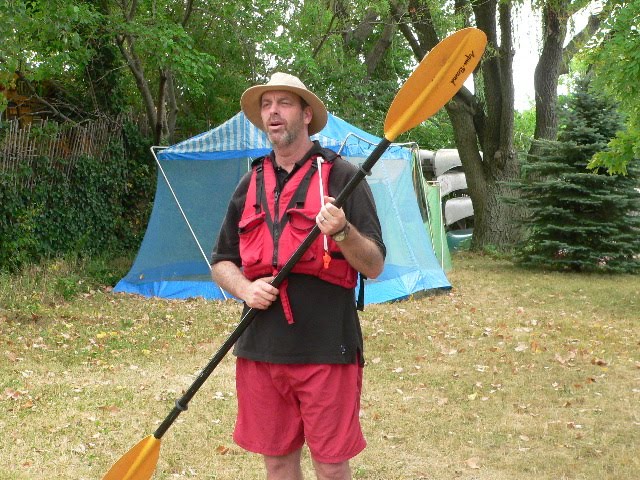
Last Sunday Sebago Kayak Club instructors Tom Potter and Walter Lewandowski ran a class for Brooklyn Bridge Park volunteers at the soon to be created boathouse at Brooklyn Bridge Park. A spectacular venue on the East River.

After the class some adventurous students and Tom, Walter, and Dottie Lewandowski paddled to rendezvous with the LIC Boathouse to observe their walk up paddling operation.

A wonderful time was had by all.


Tom Potter demonstrating strokes with the Wall Street skyline in the background


Sebago Kayak Chairman Walter attempting to keep the classes attention.