Aug 31, 2007

Traditional Greenland Deepwater Dog Rescue


Well, Kat and I just returned from our sojourn in Maine. Mornings we paddled, the bay or the lakes, afternoons we hiked. We stayed in Northport on Penobscot bay, and I brought a red sit on top with me, and rented a plastic chatham 16 to practice my rolling and greenland stroke. Well, turns out if you have a nicer looking boat, a sit on top, 2 dogs and a wife, you can forget about paddling the sea kayak. You are going to be in the sit on top. Sadly, my recent experiences have left me with a hunger for responsive boats. I get bored in a sit-on-top! So I decided, in the interest of interest, "let's include everyone on our paddles". After much research, I have reconnected with the traditional greenland method of paddling a sit on top with a squirmy pitadorabull retriever in the back. Balance wise, it's a lot like your first time on a ski. So without further ado, I give you the traditional greenland deepwater sit-on-top dog rescue. Please excuse me for not having the greenland name for this technique.


To begin with, The paddle is placed under the thighs, and Nikopotamus is encouraged to approach the tankwell from the stern at a 45 degree angle. This facilitates re-entry for both dog and "hunter".

While bracing with the legs, offer Niko a hand up. Notice how much bracing is happening.

And he's up! Now go for a paddle. When the black flies build up, you can use the traditional greenland fly swatting stroke (for another article), or if they are very bad, send him for a 10 minute swim as you paddle. The flies might go away if you are lucky.

Aug 30, 2007

Understanding fast optimal forward stroke - Part 2

The Part 1 was sent around for comments. Here is what I got;

Marcus Demuth recently circled Ireland among other kayak exploits. He is known for long journeys. He uses Werner paddle.
something I did not see mentioned, which is for me the #1 paddling/forward stroke think to know about an efficient forward stroke is the leg work. Push damn hard with your right leg against the footrest while making a stroke on your right, and same on the left side. In my world, the forward stroke happens to 60% inside the boat, and under the spray skirt (the leg work), and 40% is positioning of blade, body rotation, etc.

Marcus pointed out Eric Stiller's article from Mayor's Cup site.

Eric's points are;

The one thing I have done primarily right is to establish a fully body (foot to fingertip), torso rotating forward stroke. A stroke that continually evolves but is about 90% now. While I was aware of leg drive and torso rotation for about 20 + years, I was very happy to find the book "The Baron Mold” written by his coach and filled with excellent information and decent photos. I highly recommend you get a copy of it and EPIC kayaks DVD called "The Forward Stroke".

I have described high level sprint or marathon kayaking as hitting a T-shot with every stroke whereas the face of the paddle has a particular angle , connecting to the water at a particular speed , with a smooth delivery and follow through that is nearly as precise as hitting a golf ball with the face of driving club when done optimally.

Greg Barton has one of, if not the most efficient stroke among Olympic paddlers in paddling history. Once you establish this "high" gear you will be able to apply the basic mechanics to many different paddle angles for different distances, speeds, and conditions (like changing gears on a bicycle but the crankshaft stays the same.

Technique is 70% of the paddling performance equation and all the strength, stamina, endurance, flexibility, speed, and power training only fills in the 30%. (Good Equipment fit is given in this equation). A person with exceptional technique and moderate "fitness" will generally out perform and person with mediocre technique and high fitness.

Race speed, its cadence and the higher blade pressures put very specific demands on the body’s architecture. My torso could turn forever but the Triceps could keep up, hence a 5-10% loss of boat speed for the last 12 miles.

I had compounded this discrepancy by taking out my 212cm Epic Wing Sprint Blade for the event and joked to Greg Barton and Joe Glickman as they passed me (could I trade you for a "mid wing") a paddle with a smaller blade face. The added pressure per blade connection was not conducive to a race of this distance.

Bonnie of Frogma mentioned her blog entry "Of Paddles and Planes"

In this funny article, she loses you in airplane analogy but has some pithy points;
and if this whole aeronautical side trip is weirding you out, don't worry, my next post will be (er, at least if I don't get distracted) about my first lesson (taught by Turner Wilson) on how to actually PADDLE with a Greenland paddle!

a really good intro to the wing paddle, with excellent diagrams, by Olympic gold medalist Greg Barton, can be found here - found it while looking for images


Joe Glickman says in his article;

  • Your hands are an extension of your body," says Oscar Chalupsky. "If your body is stiff your balance is compromised. The key is to relax your body; move with the water, not against it. When in Hawaii, make like a hula dancer and roll your hips with the bumps."
  • Says Gardiner: "Experience is the best teacher of all. When the wind is blowing, force yourself to go out and get used to chop. Make sure you go with a partner, tether your paddle to your boat and paddle along the coast in case you flip.
  • "At the end of the day," says Chalupsky, "your technique will see you through the difficult conditions. The rougher the sea, the more you must concentrate on your style. Make sure you sit up straight. While you still want to concentrate on proper shoulder rotation, dropping your hands will lower your center of gravity and improve your balance. In addition, make sure you use to legs to keep yourself firmly in the kayak and to transfer your power into the boat. The key is to not let your speed drop off. The slower you go the less stable you are."
  • "Too many beginners," says Gardiner, "try and surf across a wave. The key is to take off perpendicular to a wave and drop straight down the face. Once you have the speed you can track across the wave and look for another run. Always try and keep your bow pointed down. To do that, scan the sea for holes in front of you and paddle towards them."
  • "There's a tendency," says Chalupsky, to go way off course when you're chasing the runs. Beware at all times of your final destination. This doesn't mean you have to track a straight line. You don't. But you need to keep your speed up and turn towards your destination while you're using the speed of the wave. That sounds simple but it's easy to lose sight of where you're going."

Greg Barton says in his article about wing paddle;
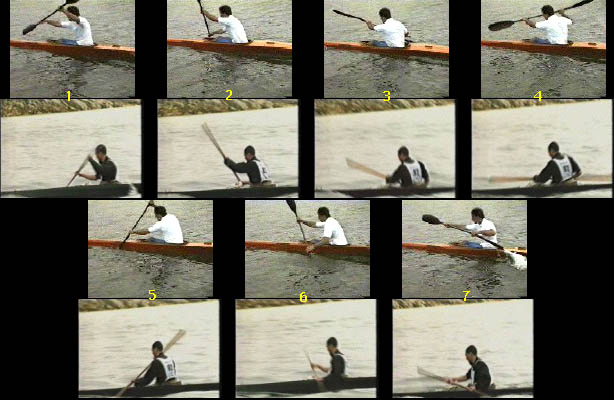
A wing paddle must be moving sideways, away from the boat in order to function properly. This is the main difference between a wing paddle stroke and a traditional stroke. With a traditional stroke (dashed line below), the paddle is pulled relatively straight back during the stroke. With a wing paddle (solid line) the stroke begins with the paddle next to the side of the kayak, but then the paddle moves steadily away from the boat during the stroke. The stroke generally finishes 12"-18" further away from the boat than it started.
Because the wing paddle is an open wing section (concave on the bottom side), water pressure builds up on the 'lip' at the leading edge of the blade and helps to push the paddle away from the kayak during the stroke. Therefore a wing paddle naturally wants to take the correct path in the water. It is best to pull straight on the paddle without forcing it into or away from the boat, letting the paddle move out on its' own. It will take a while to get used to the feel of the paddle and stroke; but once you find it, the stroke will feel very stable and comfortable. When switching back to a standard paddle, most wing users encounter a lot of flutter, as the traditional paddles do not track nearly as solidly as a wing blade in the water.


The paddle moves outward during the stroke and then exits out to the side. To begin your push for the stroke on the opposite side, do not move your hand close to your head (this would require bending your arm significantly). Instead, start your top hand push wide (away from the body where your previous stroke ended), and slowly come across with your top hand as you push forward. Towards the end of the stroke, your top hand will cross the center of the boat. This is desirable - as your blade and bottom hand move away from the kayak, your top hand should cross over this same amount. The angle of the paddle shaft when viewed from the front should remain nearly constant during the power phase of the stroke.

Water Quality Monitoring -

Without going into detail, quick question for club members. One of the guys at New York Outrigger works for an environmental engineering firm that is developing a water quality testing program involving a network of volunteers. NYO is being something of a beta tester/aquatic guinea pig for the program but once they've smoothed out the process they'll probably be looking to broaden their base of monitors. Focus of the project would be monitoring the level of floatables.

I'll bring this up more formally once I had more details on the project (probably sometime after Labor Day) but in general, does this sound like something in which people might be interested in participating? I assume the testing/monitoring is something that wouldn't fall too heavily on any one individual, for a volunteer-based thing like this to work, the duties can't be too onerous.

Understanding fast optimal forward stroke - Part 1

This series of articles is related to the forward stroke clinic by Joe Glickman. This is to help kayakers better understand elements and variables contributing to forward stroke.

Looking at masters, it is hard to learn because they seem flawless. Dissecting their behaviors and movements and comparing notes would be just as good as learning from master.

I see lots of different movements in efficient stroke;
hip twist
leg push and pull
stomach crunch
straight arms (This is a lot like rock climbing)
gentle introduction of paddle into water
meeting the water sweet spot
rotation of body to crank big muscles into gear
cadence
development of speed
speedy exit of paddle
relaxed and paced stroke for endurance

There are many variables;

type of paddle; wing, euro, greenland
type of hull; hard, soft, and shape

Unlike flatwater paddling, paddling with waves takes mindfullness; this is where my yoga comes in handy. :-)

Go and be one with water and waves..

The catch is that there are many variables. By the time, we have clinic and you can contribute better understanding of how these variables play. So study and practice your strokes. Ask away at the clinic.

For those who are armchair kayaking, here is a reading material written by our guruji, Joe Glickman. I read pages and it is a great fun book. I know I am putting Joe on pedestal. Enjoy it.

The Kayak Companionhttp://www.amazon.com/Kayak-Companion-Joe-Glickman/dp/158017485X/ref=sr_1_2/105-0593803-1050000?ie=UTF8&s=books&qid=1188482619&sr=1-2
Meanwhile, see these videos and more reading materials;
http://www.qajaqusa.org/Movies/movies.html
http://en.kayakwiki.org/index.php/Forward_stroke

http://www.kayakforum.com/Albums/Front_Comparison.jpg

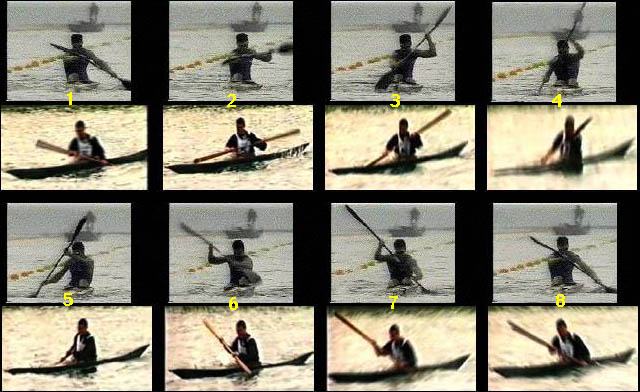
This picture compares wing paddle and greenland. You see surf ski switching and extending legs transmitting power from leg over to shoulder. Green lander enters his paddle closer and takes shorter stroke. He does little stomach crunches and shoves the boat.

http://www.kayakforum.com/Albums/Stroke_Comparison.jpg

This picture shows side view.

Here are some excerpts;

"Below is a comparison of a wing paddle forward stroke and the Greenland forward stroke. These are not completely comparable strokes as the Greenland paddle is doing a long distance race, and the wing paddle is sprinting.

http://www.kayakforum.com/Albums/Front_Comparison.jpg

The most noticable difference is the wing paddler slices his paddle out to the side in the water (Flared Stroke) where the Greenland paddler appears to pull more straight back. The Greenland paddle pushes the upper hand down across the boat, where the wing paddler pushes the upper hand horizontally across at eye level. In both cases the stroke starts out with the upper hand at nearly eye level.

http://www.kayakforum.com/Albums/Stroke_Comparison.jpg

Here you can see that both paddlers use significant torso rotation. It is quite noticable that the wing paddle crosses over the boat with his hands held high, and the Greenland paddler crosses over with hands held low.

Some of these differences may be attributed to the different kind of paddling they are doing. As you increase your stroke rate it helps to have a more vertical stroke. I have found that having the upper hand cross the centre line of the kayak at the beginning of the stroke keeps the blade in a more vertical position and forces good torso rotation. This is virtually the only cause of paddle movement, arm movement being restricted to giuding the paddle out from the boat (or rather allowing the paddle to find its own optimum direction through the water). For longer distance paddling, it is helpful to have a more horizontal stroke. Varying between sometimes more vertical and sometimes more horizontal allows better muscle recovery for longer distance trips. Also note the differences in paddle size and shape. This influences the path the paddle takes through the water and which position is most efficient."

Philippe Castagner sent an interesting article which was forwarded to me about greenland paddle. There are multiple sources of this paddling techniques not just from Maligiaq. It goes to tell you wing paddle might be inspired by greenland. For long distance paddling (> 20 miles), one could develop a different type of paddle.


http://www.qajaqusa.org/Technique/Greenland_technique_from_the_source.html

In this instance, greenland paddle acts like wing paddle; bit of bracing and getting ready for the sweet spot.

Power Phase. Maligiaq does not display as much side-to-side torso rotation as compared to an experienced paddler using the recreational stroke. Instead his pushing hand starts from just below the tip of his shoulder and is levered downward toward the deck, crossing just over the centerline of the kayak. His spine rises slightly and drops down in concert with his arm motion. His elbows stay fairly close to his sides. Viewed from the back, he looks like a boxer making slow motion, downward punches on alternating sides of his foredeck. Maligiaq's paddle shaft was held at approximately a 45-degree angle for normal cruising, higher than the paddles of the surrounding students and instructors (Note - this is the angle between the paddle shaft and the horizon, please don't confuse this shaft angle with the forward tilt of the blade discussed earlier).

The Basin as seen from a satellite.....(click on it to enlarge it)


Aug 28, 2007

Watch the Birdies!

Roz Savage is attempting to cross the Pacific Ocean, Rowing...


Here is a video of her before being rescued by the Coast Guard...for more, click here


Following her successful crossing of the Atlantic in 2006, Roz Savage is bidding to be the first woman ever to row solo across the Pacific Ocean. Her 3-stage row launches from San Francisco in Summer 2007.

This short video shows excerpts of the action from last Thursday afternoon that led up to the helicopter airlift by the US Coast Guard. What it doesn't show is the minutes Roz spent crying after she eventually succumbed to the repeated offers of assistance.

Aug 26, 2007

LI loses money due to beach closures from runoff

Toxic stormwater has helped wash away millions of dollars in beach revenue on Long Island in the first two months of the summer, Sen. Charles Schumer said yesterday.

Speaking with an empty Bar Beach behind him, Schumer said a study by Martin Cantor of Dowling College shows that municipal and state beach closures through Aug. 3 cost Long Island's tourism industry $60 million. The North Hempstead town beach was closed to bathing because of yesterday's storm, but beachgoers still could lay on the sand.

"Our beaches are under attack by stormwater runoff," the Democratic senator said.read more

Aug 24, 2007

Full Moon and paddles

August 25, 2007

We are having the 2nd full moon paddle. It starts around 7 PM with a pot luck. Last time was great.

August 26, 2007

Several members are making a trip to the Breezy Point in the morning. Contact Steve McAllister. We will head out early.

Aug 22, 2007

Urban Legend

We got an email today about a celestial event with Mars appearing as a second moon. I thought it was pretty neat, coming just after our full moon paddle, and before the full moon. But then I found out it was just another "urban legend." Ok, not quite sure why it's "urban" but whatever. Let's just all look up at the sky on the 27th, in case this is a true urban legend. http://urbanlegends.about.com/library/bl_mars_encounter.htm (was "tinkerbell" also an urban legend?)